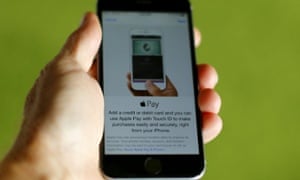
Apple’s contactlesss system that allows payment with an iPhone or Apple Watch to be available in the UK from next month
Apple Pay includes an extra security measure called tokenisation that ensures card details are never passed to a retailer.
Photograph: Mike Blake/Reuters
Apple Pay will come to the UK in July, Apple confirmed at its Worldwide Developers Conference in San Francisco on Monday.
It will be available at more than 250,000 locations - more than the number of merchants it had in the US for last year’s launch.
Participating retailers include Marks & Spencer, Costa and
Waitrose – as well as Transport for London, meaning that Tube and bus
travel can be paid for with Apple’s contactless payment system.
Apple Pay will be supported by more than 70% of the credit and debit
cards in the UK, said Apple executive Jennifer Bailey at WWDC.
The mobile payment system launched in America in 2014, alongside the iPhone 6, but has been slow to expand to other territories.
Britain is the first country outside the US to have access to use
Apple Pay, which lets users pay for things, both on- and offline, using
just their phone or watch.
When used as an offline payment system, Apple Pay works in
conjunction with an NFC (near-field communications) chip found in the
two newest iPhones and the Apple Watch to let users pay for goods by
tapping their phones on contactless card readers in stores.
In the US, the system took a marathon of deals to put together, with
Apple negotiating with banks, retailers and credit card companies
individually to build enough support.
Elsewhere, however, the launch is expected to be much simpler because
Apple Pay uses the same technology as that found in conventional
contactless card readers, already common across much of Europe and Asia.
Advertisement
But
unlike contactless cards, Apple Pay includes an extra security measure –
tokenisation – which ensures that the card details stored on a phone
are never passed to the retailer. Instead, the payee receives a one-use
“token”, which allows them to debit the payment but cannot be reused in
future.
Online, Apple Pay uses the same tokenisation system to speed up and
secure e-commerce, letting iPhone owners pay for goods on supported
websites with just a tap of their finger on the phone’s fingerprint
reader.
In the US, uptake of Apple Pay was strong, with more than 40% of
iPhone 6 owners having used it at least once, according to Auriemma
Consulting.
But the service was hampered by a need to bring partners in one by
one, leading to some major hold-outs: most notably Walmart, which is
already waging a war against credit card firms over merchant fees and reportedly views Apple Pay as merely perpetuating an expensive system.
This is dummy text. It is not meant to be read. Accordingly, it is difficult to figure out when to end it. But then, this is dummy text. It is not meant to be read. Period.


ConversionConversion EmoticonEmoticon